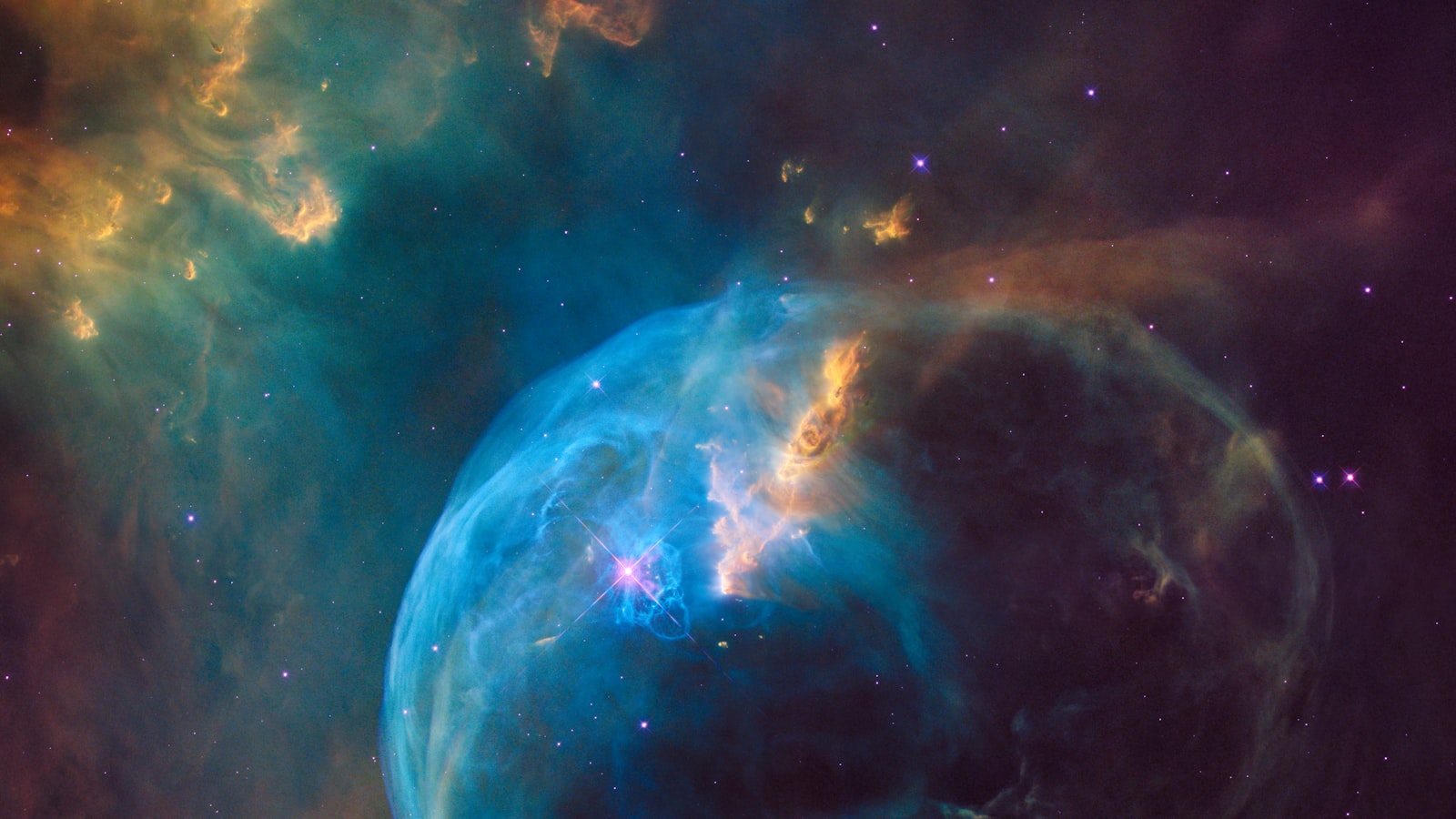
A black hole sounds like science fiction, a cosmic drain that swallows everything nearby. The real thing is stranger and more precise than the myth. At its heart, a black hole is a simple idea taken to an extreme: pack enough mass into a small enough space, and gravity becomes so strong that not even light can get away.
Escape velocity, the key idea#
To understand black holes, start with something familiar: throwing a ball up in the air. The harder you throw, the higher it goes before gravity pulls it back. Throw it fast enough, and it could in principle leave Earth entirely. The minimum speed needed to break free of an object's gravity is called its escape velocity.
For Earth, escape velocity is high but reachable, which is why rockets can leave. For the Sun it is higher. The denser and more compact an object is, the stronger its surface gravity and the higher its escape velocity climbs.
Now push that idea to its limit. Imagine an object so dense that its escape velocity reaches the speed of light. Light is the fastest thing in the universe, so if even light cannot move fast enough to escape, then nothing can. That object is a black hole.
Most black holes are the corpses of giant stars. A star is a constant balancing act between two forces:
- Its own immense gravity, trying to crush it inward.
- The outward pressure from nuclear reactions in its core, pushing back.
For millions of years these forces hold a stalemate. But a star eventually runs out of fuel for those reactions. When the outward push fades, gravity wins. For a sufficiently massive star, the core collapses catastrophically, often after a brilliant explosion called a supernova that blasts the outer layers into space.
What remains can be crushed into an unimaginably small, dense point. If enough mass is squeezed tightly enough, the escape velocity at its boundary passes the speed of light, and a black hole is born. There are also far larger supermassive black holes, millions or billions of times the mass of our Sun, sitting at the centers of galaxies, including our own. Exactly how they grew so large is still an active area of research.
The event horizon: a point of no return#
The most important feature of a black hole is not a solid surface but a boundary in empty space called the event horizon. It marks the line where the escape velocity equals the speed of light.
- Outside the event horizon, escape is still possible, though it gets harder the closer you get.
- At the event horizon, you would need to travel at light speed to get out, which nothing with mass can do.
- Inside the event horizon, all paths lead inward. There is no direction you could travel, however fast, that points back out.
This is why a black hole looks black. Light that crosses the horizon cannot come back to your eyes, so the region appears as a perfectly dark void. The event horizon is not a wall you hit; it is simply the last boundary from which any signal can ever reach the outside universe. Cross it, and you are cut off for good.
The size of this horizon depends on mass. More mass means a larger event horizon. For a black hole the mass of the Sun, the horizon would be only a few kilometers across, which shows just how extreme the density is.
Warped space and slowed time#
Here is where black holes become genuinely mind-bending. According to our best understanding of gravity, mass does not just pull on things; it bends the fabric of space and time around it. A useful (if imperfect) picture is a heavy ball resting on a stretched rubber sheet, creating a dip that nearby marbles roll into. A black hole is like a bottomless funnel in that sheet.
This warping has a strange consequence for time. The stronger the gravity, the slower time runs compared to a distant observer. Near a black hole, time would crawl. If you watched a friend fall toward one, you would see them appear to slow down and freeze near the event horizon, their light stretching and dimming, rather than vanishing in an instant. From their own point of view, though, time would feel completely normal as they crossed. Both perspectives are real; this is one of the deepest and most counterintuitive lessons of gravity.
Common misconceptions, cleared up#
- 'Black holes suck everything in.' They are not cosmic vacuum cleaners. From a safe distance, a black hole's gravity behaves just like that of any object with the same mass. If our Sun were magically replaced by a black hole of equal mass, Earth would keep orbiting exactly as it does now, just in the dark. You only get trapped if you cross the event horizon.
- 'A black hole is a giant solid object.' The event horizon is a boundary in space, not a surface. The dramatic part is a region, not a thing you can land on.
- 'Nothing ever comes out.' Matter falling toward a black hole often swirls into a superheated, glowing disk before crossing the horizon, and this can blaze brightly across the universe. The blackness is only inside the horizon, not the chaos around it.
How we know they are real#
We cannot see a black hole directly, since it emits no light. But we can see its effects. Astronomers track stars whipping around an invisible, incredibly massive point at the center of our galaxy. They detect the brilliant glow of matter heating up as it spirals inward. And in recent years, instruments have captured ripples in space itself, set off when two black holes collide and merge. Each of these is a fingerprint of something that is invisible by definition, observed through what it does to everything around it.
Where it shows up in daily life#
Black holes feel impossibly remote, yet the same physics touches the ground beneath you. The fact that gravity slows time, the headline feature of black holes, is real and measurable even on Earth, and satellite navigation systems must account for tiny time differences between orbit and the surface to stay accurate. The extreme case lives in space, but the principle is woven into technology you use every day.
The takeaway#
A black hole is a region where mass is packed so tightly that escape would require beating the speed of light, which nothing can do. They form when massive stars collapse, they are bounded by an event horizon that marks the true point of no return, and they bend space and slow time around them. Far from being a fantasy, they are a logical, well-tested consequence of how gravity works, taken to its ultimate extreme.