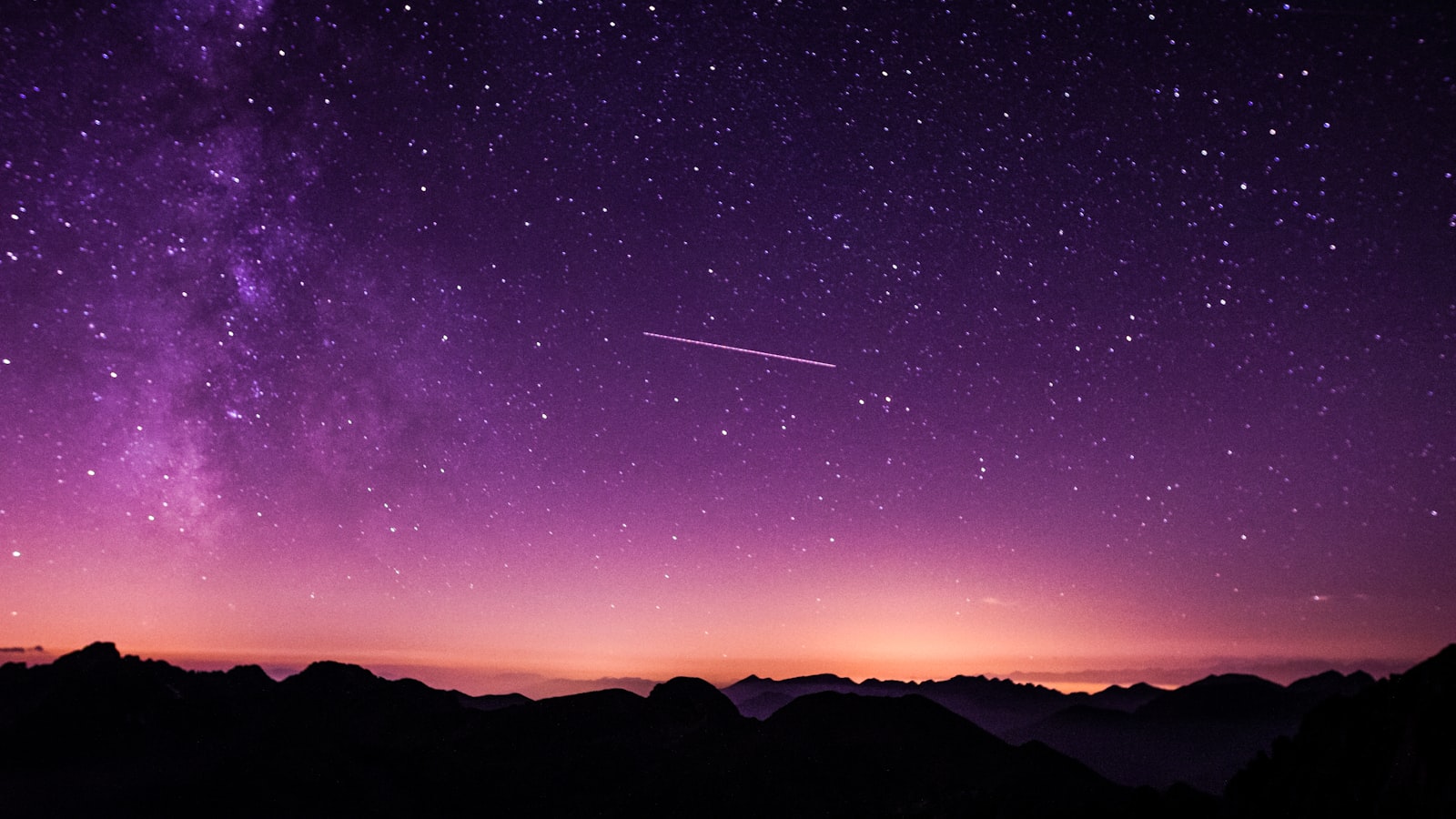
Look up on a clear day and the sky is a deep, even blue. Yet the sunlight pouring down on you is white, and the air it passes through is invisible. So where does all that blue come from, and why does the very same sky blush orange and red at sunset? The answer is a single, elegant piece of physics about how light bounces off the air itself.
White light is a mix of colours#
The first thing to know is that sunlight only looks white. It is actually a blend of every colour, from red and orange through to blue and violet. A prism, or a rainbow, simply spreads that blend out so you can see the separate colours that were there all along.
Each colour is a wave of light, and the colours differ in their wavelength, the distance from one peak of the wave to the next:
- Red light has a long wavelength, like a slow, stretched-out ocean swell.
- Blue and violet light have short wavelengths, like quick, choppy ripples.
This difference in wavelength is the whole reason the sky has a colour at all. When white sunlight meets the air, the different colours do not behave the same way.
Air scatters blue more than red#
The sky is full of gas molecules, mostly nitrogen and oxygen, which are far too small to see. When sunlight hits these tiny molecules, the light gets scattered, meaning it is knocked off its straight path and sent flying in all directions.
Here is the key rule: shorter wavelengths scatter much more strongly than longer ones. Blue light, with its short, choppy waves, gets bounced around the sky far more than red light, which mostly carries straight on. This selective bouncing is called Rayleigh scattering, named after the physicist who first explained it.
A useful analogy: imagine throwing a tennis ball and a beach ball at a thin forest of poles. The small tennis ball clips the poles often and ricochets all over the place, while the big beach ball sails between them and keeps going. Blue light is the tennis ball, bouncing everywhere; red light is the beach ball, passing through.
Why the daytime sky looks blue#
Now put it together. As sunlight crosses the atmosphere, blue light is scattered out of the direct beam and flung across the whole sky. When you look up at any patch of sky away from the sun, the light reaching your eyes is this scattered blue light, arriving from every direction. That is why the sky glows blue all over, not just where the sun is.
You might reasonably ask why the sky is not violet, since violet light has an even shorter wavelength and scatters even more. There are two reasons:
- The sun sends out less violet than blue to begin with.
- Our eyes are more sensitive to blue than to violet.
The result your brain settles on is the familiar sky blue, a blend that leans toward blue rather than violet.
Why sunsets turn red#
The same physics explains the opposite-looking sunset. The difference is simply the path the light has to travel to reach you.
At midday, the sun is overhead and its light takes a fairly short route straight down through the atmosphere. At sunrise and sunset, the sun sits low on the horizon, so its light skims through a much thicker slice of air to reach your eyes.
Over that long journey, so much blue light is scattered away that hardly any is left in the direct beam by the time it arrives. What remains are the longer wavelengths, the oranges and reds, which scatter least and survive the trip. Those are the colours you see glowing on the horizon. In short:
- Short path (midday): plenty of blue left to scatter overhead, so the sky is blue.
- Long path (sunset): blue has been scattered out along the way, leaving warm reds and oranges in the direct light.
This is also why a hazy or dusty sky can deepen a sunset. Extra particles in the air scatter even more of the remaining light, often making the colours richer.
Common misconceptions#
A few tidy myths deserve correcting:
- The sky is not blue because it reflects the ocean. It is the other way round, if anything: water can look blue partly because it reflects the sky. The sky's colour comes from scattering in the air, not from the sea.
- Clouds are white, not blue, for a reason. Cloud droplets are much larger than gas molecules, so they scatter all colours roughly equally. Mixed back together, all colours make white. That is why clouds and fog look white or grey rather than blue.
- The blue is not added by anything in the air. No dye, dust, or pollution is needed. Pure, clean air on a clear day still produces a blue sky, because the scattering is done by ordinary gas molecules.
Where you meet it in daily life#
This single idea explains a surprising amount of what you see. The deep blue of a clear afternoon, the fiery colours of a good sunset, the soft glow of twilight, and even the pale, washed-out blue near the horizon on a hazy day all trace back to how air scatters short wavelengths more than long ones. Photographers chase the warm light of the golden hour for exactly this reason, and pilots and sailors read the colours of the sky as a rough guide to the air's clarity.
The takeaway#
Sunlight is a mix of all colours, and the tiny molecules in air scatter the short, blue wavelengths far more than the long, red ones. That scattered blue, arriving from all directions, paints the daytime sky. At sunset the light travels a longer path through the air, the blue is scattered away before it reaches you, and the leftover reds and oranges set the horizon aglow. One rule, Rayleigh scattering, quietly colours nearly every sky you will ever see.