You step off a train in an unfamiliar city, open a map, and a blue dot drops onto your exact spot within seconds. No cell tower asked where you were. No one typed in your address. Your phone figured it out by listening to faint signals from satellites circling thousands of miles overhead. Here is how that quiet miracle actually works.
A constellation of clocks in the sky#
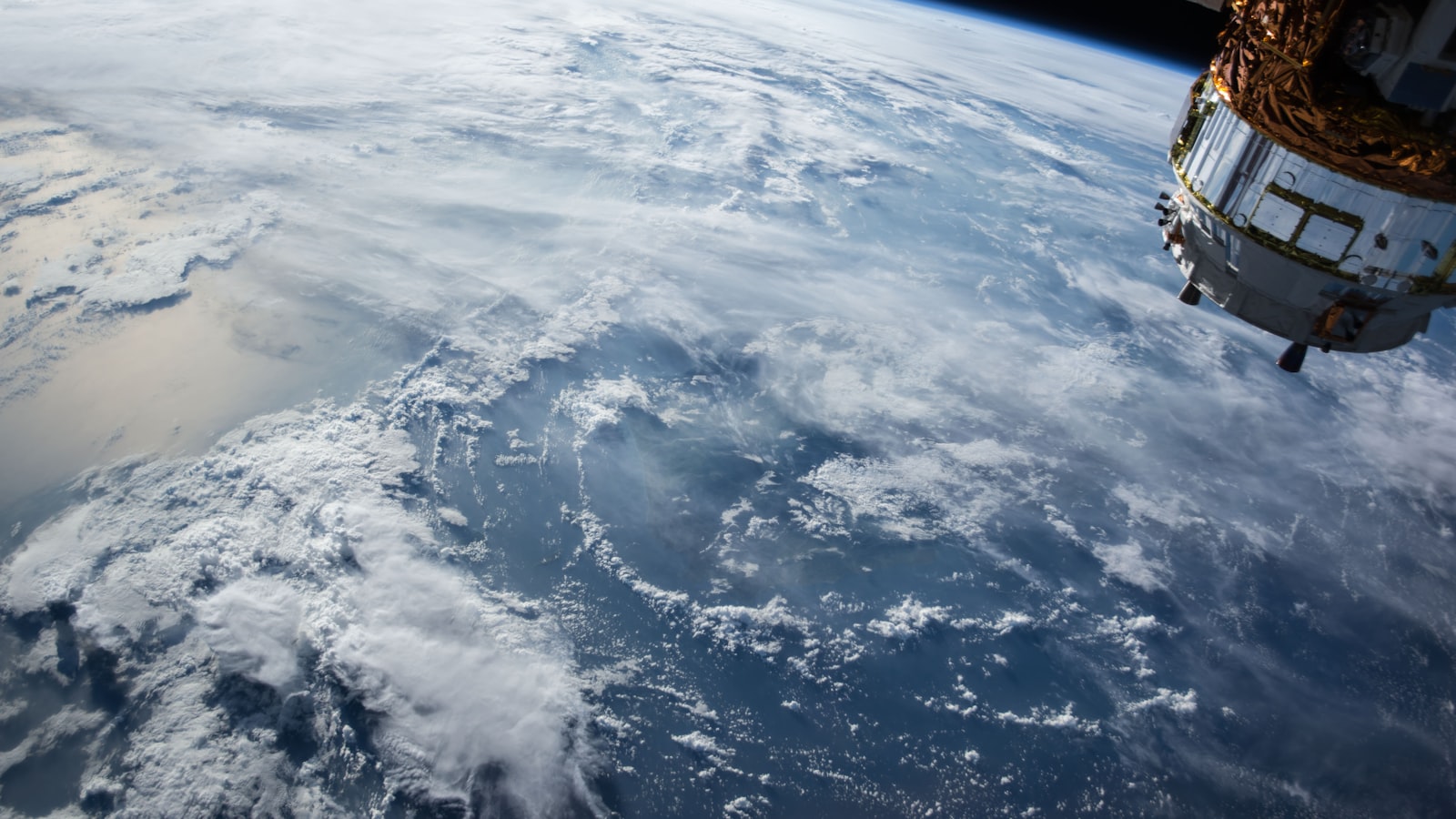
GPS stands for Global Positioning System. At its heart is a group of satellites orbiting high above Earth, arranged so that from almost any open spot on the planet, several are overhead at once.
Each satellite does something deceptively simple: it constantly broadcasts a radio message that says, in effect, "I am satellite number X, here is exactly where I am in my orbit, and here is the precise time right now."
That is essentially the entire transmission. The satellites do not track you, talk back, or know you exist. They simply shout their identity, location, and the time, over and over, to anyone listening below.
The single most important thing on each satellite is its clock — an atomic clock of extraordinary precision. As you will see, GPS is really a problem of timekeeping disguised as a problem of geography.
Distance from a time delay#
Your phone's GPS receiver picks up these broadcasts and performs one key calculation: how long did each signal take to arrive?
Radio signals travel at the speed of light, which is fast but not instant. By comparing the time stamped in the message to the time the signal actually arrives, the receiver works out the travel time. Multiply travel time by the speed of light and you get distance:
distance = speed of light × travel time
So from a single satellite, your phone learns one fact: I am exactly this far from that satellite. That one number does not tell you where you are, but it dramatically narrows things down.
Picture it as a sphere. If you know you are, say, 20,000 kilometers from a particular satellite, you must be somewhere on the surface of an imaginary sphere of that radius centered on the satellite. You are on the sphere, but you could be anywhere on it.
Why you need several satellites#
One sphere is not enough, so your receiver listens to several satellites at once and overlaps their spheres. This is the idea behind trilateration — closely related to triangulation, but based on distances rather than angles.
Here is how the spheres narrow you down:
- One satellite: you are somewhere on a sphere.
- Two satellites: two spheres overlap in a circle. You are somewhere on that circle.
- Three satellites: three spheres intersect at just a couple of points, and one of them is usually obviously wrong (off in space), leaving your location.
- Four satellites: the fourth pins down the answer in full three dimensions and fixes a critical timing problem.
A down-to-earth analogy: imagine friends in three different cities each tell you "you are 100 miles from me." Each statement draws a circle on the map. Where all three circles cross is the only place that satisfies everyone — and that is where you must be. GPS does the same thing with spheres instead of circles.
The clock trick that makes it work#
There is a catch. The whole method depends on knowing travel time extremely precisely, and travel time depends on comparing the satellite's clock with your receiver's clock. Satellites carry pricey atomic clocks. Your phone does not — its little clock is nowhere near accurate enough on its own.
Even a tiny clock error matters enormously. Because signals move at the speed of light, being off by a millionth of a second translates to a position error of hundreds of meters. So how does a cheap phone clock produce a few-meter result?
This is the elegant part. The receiver treats its own clock error as an unknown to be solved, not a number it already knows. With four satellites, it has enough information to solve for four things at once:
- Your position east-to-west
- Your position north-to-south
- Your altitude
- The exact correction needed for its own clock
That is why four satellites give a full 3D fix. The fourth satellite is not just extra confirmation — it is what lets a cheap receiver mathematically reconstruct the precise time, and through it, your location.
Why GPS sometimes struggles#
Understanding the mechanism explains GPS's everyday weaknesses:
- Indoors and underground: the signals are faint and easily blocked by roofs, concrete, and earth, so your fix is poor or vanishes.
- Urban canyons: tall buildings bounce signals around, so they arrive late and confuse the timing math. The blue dot drifts.
- Tree cover and storms: dense foliage and heavy weather can weaken the already-faint signals.
To smooth this over, your phone usually blends GPS with other clues — nearby Wi-Fi networks, cell towers, and its motion sensors — to keep the dot steady when satellites alone are not enough.
Common misconceptions#
A few myths are worth clearing up:
- "GPS tracks me and the satellites know where I am." They do not. GPS is one-way. Satellites only broadcast; your device does all the listening and calculating. The satellites never receive anything from you. (Tracking happens when an app you installed reports your computed location elsewhere — a separate matter, and one worth reviewing in your settings. This is general guidance, not security advice.)
- "GPS needs an internet connection." The core positioning does not. A phone can compute its location from satellite signals alone; the internet is only needed to download maps and the occasional helper data that speeds up the first fix.
- "GPS is American-only." GPS is the U.S. system, but several other global satellite navigation systems exist, and modern phones quietly use several of them together for better accuracy.
The takeaway#
GPS feels like the satellites are watching you, but the truth is the reverse: they simply shout their position and the time, and your phone listens. By measuring how long each signal took to arrive, your device turns those time delays into distances, overlaps several of them, and solves for where all the spheres meet. The masterstroke is using a fourth satellite to correct your phone's imperfect clock, turning cheap hardware into a few-meter fix. It is, at heart, a triumph of precise timekeeping — geography is just the byproduct.